

1. Overview of the Case
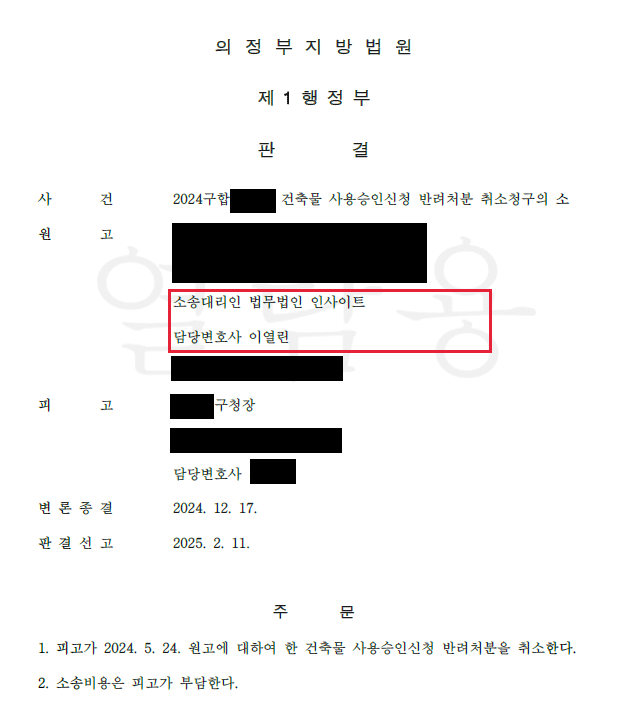
A business operator, after newly constructing a livestock barn, applied to the competent district office for approval of use of the building, but received a rejection disposition on the ground of "concern over harm to the public interest due to odor generation." However, the operator had completed the facility in accordance with the design for which the building permit had been granted, and had also installed odor-reduction facilities. Accordingly, judging it unjust that the district office had refused approval on abstract grounds even though the operator was legally entitled to a proper use approval, the operator entrusted the legal response to Law Firm Insight.
2. Key Issues and Response
The core issues in this case were as follows.
(i) Whether the district office's rejection disposition of the use approval was a lawful measure under the Building Act.
(ii) Whether refusing use approval on the ground of an odor problem conformed to the principles of administrative procedure.
(iii) Whether the operator could assert its legitimate rights under the principle of protection of trust.
Law Firm Insight emphasized that the disposition did not constitute a ground for refusing use approval under the Building Act, and that the odor generation problem could be resolved through separate administrative measures.
In addition, the firm developed the argument that refusing use approval only for a specific facility, even though similar facilities were being operated in the same area, was contrary to the principle of equity. Furthermore, the firm highlighted that refusing use approval belatedly, in a situation where the operator had completed the facility in reliance on the permit, violated the principle of protection of trust.
3. Outcome and Significance
The court accepted Law Firm Insight's arguments, ruling that the district office's rejection disposition of the use approval was unlawful and cancelling it.
As a result, the operator was able to recover the legal right to operate the facility as planned, and the firm secured a ruling that could serve as an important precedent for other operators facing similar problems.